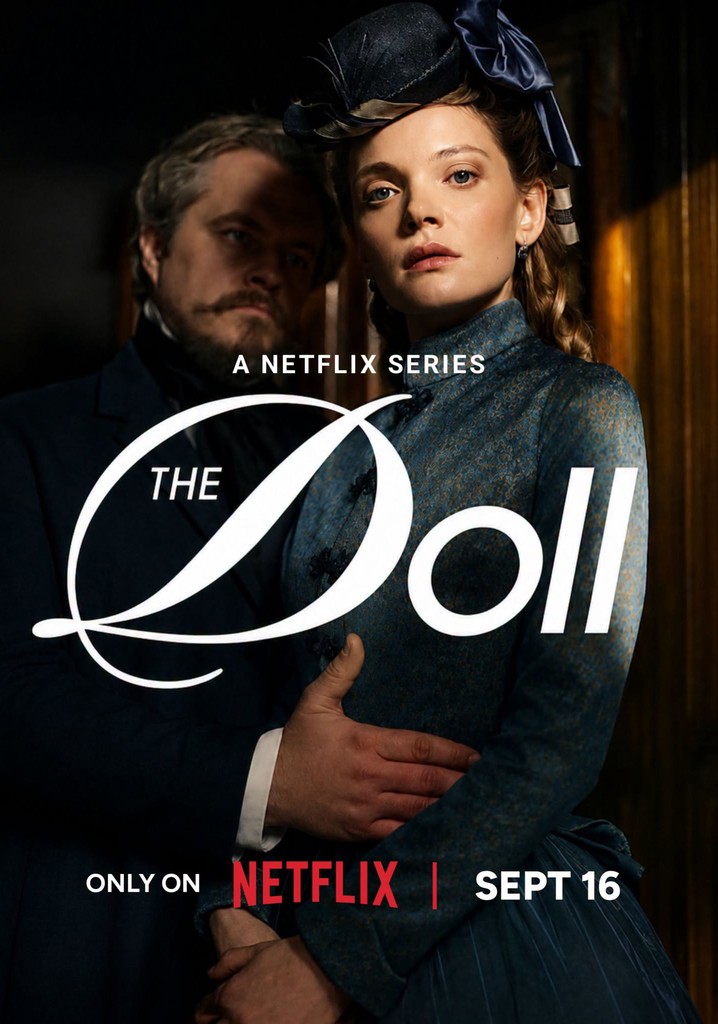
An unprecedented situation is set to unfold in Polish cinema this month. Two different producers are planning to release a film entitled The Doll. The sensation, however, lies not in the similarity of the titles, but in the fact that both releases are screen adaptations of Bolesław Prus’s novel of the same name. The cinema release is scheduled for 30 September, whilst the six-episode series is available on Netflix from 16 September. It is therefore certain that the two Dolls will be in fierce competition with one another.
Is this a marketing ploy?
No. Netflix is known in the industry for keeping information about new productions under wraps for a long time. So, when, in 2024, the film production company Gigant Films announced a feature-length adaptation of the novel, work on the Netflix series was reportedly already at an advanced stage. However, neither side was prepared to back down, and both decided to go ahead with their respective projects.
The Novel
The Doll, one of the greatest achievements of Polish literature and a masterpiece of 19th-century realism, written by Bolesław Prus, was first published in 1890. The Dutch edition, translated by Karol Lesman, was published in 2015 and received excellent reviews in the Netherlands.
The book offers an almost journalistic portrayal of life in Warsaw in the 1870s, presenting a broad social and historical panorama. The central theme of the novel, however, is the love of a wealthy merchant, Stanisław Wokulski, for the far less wealthy but well-connected aristocrat, Izabela Łęcka. The story of Wokulski’s ambitions and disappointments provides a pretext for reflections on the clash between tradition and modernity. On an emotional level, it is a conflict between a romantic and a pragmatic vision of the world.
How do the two productions differ?
First and foremost, in their format. But also, in their approach to the source material. Whilst the feature film is a faithful adaptation of the novel, the Netflix series deviates significantly from the original text. And this is where the controversy begins. The series has altered not only the characters’ fates, but also their personalities and the atmosphere of the novel. The creators explain that this will make the story more accessible and relevant to contemporary viewers. Thus, the ethereal and somewhat listless Izabela Łęcka becomes a self-assured, predatory woman, and the screen is frequently peppered with swear words – something entirely at odds with 19th-century bourgeois propriety. After the series’ trailer was released online, the internet went into a frenzy. For The Doll is a beloved classic of Polish literature, read by generations, and for many, tampering with its content is unacceptable, regardless of the intentions.
How are they similar?
Both productions boast an impressive star-studded cast. In the film (directed by Maiciej Kawalski), we’ll see Krystyna Janda, Marcin Dobrociński, Kamila Urzędowska and Marek Kondrat, who has returned to acting after many years to play the role of shop assistant Rzecki (watch the trailer). The Netflix series (directed by Paweł Maślona) features Sandra Drzymalska, Tomasz Schuchardt, Magdalena Cielecka and Piotr Adamczyk. Both were produced on a grand scale. Filming took place in the most authentic locations possible, with hundreds of extras and hundreds of historically accurate costumes created in collaboration with renowned Polish fashion designers. Tomasz Ossoliński and Gosia Baczyńska worked on the cinema version, whilst for the Netflix, the costumes were overseen by the renowned set and costume designer Dorota Roqueplo.
Taking a broader view
Prus’s novel has been adapted for the screen twice in the past. In 1968, a feature film directed by Jerzy Hass was made, and in 1977 a television series directed by Ryszard Ber, with the unforgettable soundtrack by Andrzej Kurylewicz.
We will find out in the coming weeks which of the latest adaptations of The Doll proves to be the greater success. Regardless of the outcome of this competition, however, it is certainly worth reading the novel itself, which vividly depicts human emotions, surprisingly topical social dilemmas and the city of Warsaw as it was 150 years ago.
Monika Gimblett
Image: Netflix / Michał Klusek